


PICTURE BOOK FODDER

August 24th, 2018
082018_angledUP

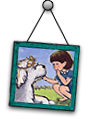
In this story, a mouse’s squeak sets off a chain reaction that wakes all the animals in the surrounding meadows and mountains. I painted the illustrations in black and white gouache resist and my sister Kate McGee colored them in Photoshop, as we did for Little Wolf’s First Howling. 

THE ILLUSTRATIONS for SQUEAK! are delivered to Philomel for publication next spring. So it is time to scratch around for a new project. How to begin?

BEGIN as a cobbler – laying out all the pieces of the story on the bench. It’s going to be a shoe, but what sort of shoe? Bright buckles? Strong arch support? High heeled, strappy, patent leather?

Begin with an overheard line: “As long as you’re home in time for wormcakes,” or “You’re just a baby. A baby, baby, baby,” or “I remember he was missing a few fingers.”

Begin with a character and the stakes: a child in jeopardy, a badger or weasel or mouse with unquenched desire. Yearning is not enough, begin with clear need.

Begin with a sequence: days of the week, or the five senses, cities along a highway. Sequence can open up a writing experience. Begin there

or with place. Begin with a place that holds memories of the life lived there: the janitor’s hideout in the school basement, a dresser drawer that served as a cradle, a sun-parched hillside.

FREEDOM flows when I approach the blank page. In some ways a new beginning feels like the first time I tried to write anything. In other ways, I lean on 27 years of making picture books.

I think of Seahawks football coach Pete Carroll, talking about the freedom that players gain when they master their skills. He said: “Think of a dancer. Dancers work and they work and they work and they master their skill – or singers – they master their skills so far that improvisation just comes flowing out of them. Their natural expression of the best they can possibly be comes out of them because there is no boundary to hold them back.”

I hope for such intuitive leaps, but am aware of my shortcomings, too, and appreciate encouragement from Leonard Cohen’s Anthem:

      Ring the bells that still can ring. Forget your perfect offering. / There is a crack in everything – that’s how the light gets in.

BEGIN. Let the world fall away and follow the path into the story – as long as you’re home in time for wormcakes.

Story and Connection – A Letter to Hannah Gadsby

July 20th, 2018

Screen Shot 2018-07-16 at 11.39.55 AM

Dear Hannah Gadsby,

I am writing this with tears in my eyes, having just watched your Netflix comedy special, Nanette.

I had to watch it twice to appreciate how you wove together – with humor – threads of your coming out story and assault, insights about the cost of turning your story into comedy, analysis of comedy structure v. story structure, your experiences with unsolicited advice givers and anti-depressives, and, even, info from your undergrad degree in Art History. You brought these storylines together for maximum impact, making a indelible case for embracing multiple perspectives.

It is so much more than a comedy special, which seems to be stirring up a bit of controversy. Did you see where Judy Berman in the New York Times wrote, “The controversy surrounds the nature of Nanette, which is packaged as comedy but evolves into a searing critique of that medium when, midway through her set, Gadsby announces that she’s quitting stand-up. A lesbian from conservative Tasmania, she is done mining past trauma for jokes. Instead, Gadsby launches into a shrewd and impassioned dissection of misogyny, homophobia, art history and especially comedy. Is it fair to call this stand-up? Opinions vary.”

Whatever you want to call it, your brilliant performance gathers steam as it goes. I put your closing words above my computer:

“Laughter is not our medicine. Stories hold our cure. Laughter is just the honey that sweetens the bitter medicine.

“I don’t want to unite you with laughter or anger. I just needed my story heard, my story felt and understood by individuals with minds of their own. Because like it or not your story is my story and my story is your story. I just don’t have the strength to take care of my story anymore. I don’t want my story defined by anger. All I can ask is just please help me take care of my story.

“Do you know why we have The Sunflowers? It’s not because Vincent Van Gogh suffered. It’s because Vincent Van Gogh had a brother who loved him. Through all the pain, he had a tether, a connection to the world and that is the focus of the story we need.

“Connection.”

Screen Shot 2018-07-16 at 12.13.30 PM

Hannah, I want you to know I will take care of your story. I think that’s my purpose on this earth – to take care of stories. One of my first picture books, published 22 years ago, is about a princeling who finds his own dreams. The most recent is about a little wolf who sings his own song. I agree our diversity is our strength; there is room for all our dreams, all our songs, all our stories. The first thing I will do to take care of your story is to share it with the BATT blogpost readers.

Your very specific, individual story is universal. That’s the way stories work. They connect us to a world where everyone is welcome at the table. Thanks again for your wonderful special.

Yours truly, Laura

Alaskan Stories Sewn and Carved

June 15th, 2018

Last week Julie P. wrote about the picture books she discovered on her journey to Portugal. This week, I plan to share some art and stories from our trip to Southeastern Alaska.

We traveled by small boat – an Uncruise – chugging up the inlets of the Inland Passage between Juneau and Ketchikan, everyday kayaking and hiking into the fiords and forests.
jkpaddleAKI grew up near Yosemite in California and I think the best way to describe this scenery is to imagine Yosemite – the towering granite cliffs, the waterfalls – filled with salt water. In addition to the animal life you’d find in Yosemite, like bears and mink and eagles, the Southeastern Alaska wilderness is home to whales, sea lions and harbor seals, etc. Yes, it was amazing.

But just as intriguing was the opportunity to learn about the native people of this area – the Tlingit, Haida and Tsimshian. Our trip included a visit to the Chief Shakes longhouse in Wrangell.

IMG_3419

There, a man named Arthur talked about the history of the Tlingit people and the building of the longhouse, and, more personally, the history of the blanket robe he wore, a garment that had originally been his grandmother’s.

With the robe for illustration, Arthur talked about the two “moieties” in the Tlingit tribe: eagle and raven. Families follow a matrilineal line and marriages are traditionally only allowed between one of each moiety. Arthur’s grandmother was of the eagle clan, thus the eagle at the top front of his blanket.

During his grandmother’s youth, the western government disallowed all tribal regalia as well as the Tlingit language. Grandmother’s robe, made of black and red government-provided blankets and decorated with white buttons, was hidden between the studs of her house.

When Arthur was a young man, his grandmother showed him the robe, then returned it to its hiding place. “It kept us warm, even then,” Arthur said. Thirty years later, Arthur’s family sold the house and the new owner remodeled. A demo crew found the robe and set it aside. The new owner noticed it and stuffed it into a trash bag. When the owner left, workers rescued the robe and gave it to a tribal leader who recognized that it had belonged to Arthur’s grandmother. Five years ago when Arthur left his job as a fisherman to learn more about his Tlingit culture, he took a Tlingit name. The tribal leader gifted him back his grandmother’s robe, which he has altered to fit. Over the years he added an Orca on the front and Wolf and Bear images on the back – each depicting other parts of his family.

IMG_3424

Arthur’s robe is a visual reminder of his family lineage in Tlingit images. In a culture that had no written language, the robe holds the stories.

In Ketchikan at the end of our journey, we met Jason, a Tsimshian guide, in the Totem Heritage Center. He unwound the stories of five ancient totem poles. He told us how totem poles could have a funerary or commemorative use, or tell a family’s history. But this particular one was made to tell a cautionary tale.

Screen Shot 2018-06-14 at 8.23.42 PM

As Jason told us, the face featured is that of a strong and arrogant man who went out fishing. He didn’t want to wait for his partner so he went alone. “That’s when the Alaska weather showed up,” Jason said. Waves capsized the man’s canoe. “The mythological killer whale people saw him. They recognized him as a strong and important person and saved him, bringing him underneath the water to the mythological village of the killer whale people.” They revived him, so he stayed with them for many years to repay them.

Eventually he got homesick. He realized he was not strong enough as a regular man to make it from the bottom of the ocean to the surface. “So he wrapped himself in a sealskin and transformed himself into a seal – until he broke the surface of the ocean and returned to his people.”

Jason added that there are two morals from this story: “Never go out fishing alone, and always take care of those who take care of you.”

This totem pole, unlike most, is carved on all sides. The seal’s skin wraps around the man, with the head of the seal (a little damaged due to age) rising straight above the man, as the seal swims up to the surface of the water.

Stories and storytellers and the beautiful native art that holds the stories surely added to our Southeastern Alaska adventures. These tribes’ oral storytelling traditions relied on art made from materials at hand: fabric, buttons and sewing needles, and huge cedar logs. But the urge to tell a story with words and images is the same urge we picture book people feel. It’s a part of the human condition.


Bio | Books | Programs | Journal | Fun & Games | Contact | Home
Copyright © Laura McGee Kvasnosky 2008-Present